
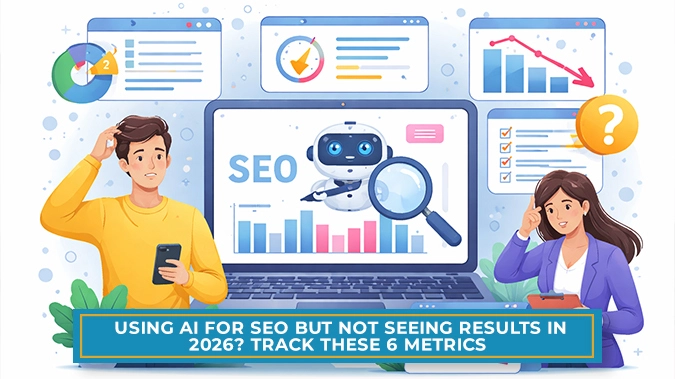
Using AI for SEO But Not Seeing Results in 2026? Track These 6 Metrics
AI SEO in 2026 delivers results only when performance is measured with the right metrics. Tracking organic traffic, keyword movement, CTR, engagement, conversions, and AI visibility helps identify what’s working and what’s not. Without these insights, AI-generated content may fail to rank, making data-driven tracking essential for improving SEO outcomes and achieving consistent growth.
Overview:
AI SEO in 2026 only delivers real results when performance is tracked using the right metrics, not just content output.
Key metrics to track for AI SEO success:
- Organic traffic growth to measure real visibility and user reach
- Keyword movement and topical authority to assess ranking strength
- Click-through rate (CTR) to evaluate search appeal
- Use of engagement metrics such as time on page and scroll depth
- Conversion rate to track business impact
- AI visibility and citations to measure presence in AI-driven search results
Honestly asking. Are you still doing SEO the same way you were doing a few years back? And are you getting the same results you used to? The answer is surely no. This is not because you are doing something wrong, but because the whole game has significantly shifted.
In 2026, AI has changed the way search has been performed in early days. Now it is everywhere and in every search. Google’s AI Overview, or Bing’s AI-powered answers, or tools like ChatGPT and Perplexity, have changed how individuals find all the information online.
If you are wondering why AI content is not ranking in Google or struggling to measure ROI, the issue isn’t AI itself. It’s the lack of performance tracking. In 2026, success in SEO is no longer about how much content you produce, it is about how well you measure what’s working. This guide breaks down the AI SEO metrics that actually matter and shows you how to turn AI-driven efforts into measurable results.
Why AI SEO Alone Doesn't Guarantee Rankings
AI tools have made content creation faster, easier, and more scalable than ever before. Businesses can now generate blogs, landing pages, and even full content strategies within minutes. However, this convenience has also led to a major challenge, which is content saturation. With thousands of AI-generated articles being published daily, standing out in search results has become significantly harder.
More importantly, AI alone cannot replace strategy. Search engines in 2026 are smarter, focusing not just on content volume but on relevance, intent, authority, and user experience. Without a clear direction and performance tracking, AI-driven efforts often fail to deliver meaningful results.
Here’s why many AI SEO strategies fall short:
- AI content saturation: Search engines are flooded with similar, templated content generated using the same tools and prompts. This lack of uniqueness makes it difficult for pages to differentiate, reducing their chances of ranking well.
- Lack of strategy: Many businesses rely on AI to produce content without defining goals, target audience, or keyword intent. Without a structured plan like topic clusters or content funnels, even high-quality content struggles to perform.
- Missing tracking: Publishing content without measuring performance is one of the biggest mistakes. Businesses often overlook key digital marketing KPIs such as organic traffic, engagement, and conversions, which are essential to evaluate what’s working and what needs improvement.
Without a structured approach, human refinement, and proper tracking systems in place, even the most advanced tools will fail to deliver consistent and meaningful AI SEO results.
The 6 Metrics That Actually Show AI SEO Success
Tracking the right metrics is essential to ensure your AI SEO strategy is delivering real results. Here’s a breakdown of the six key indicators every marketer should monitor:
1. Organic Traffic Growth
Though impressions indicate website visibility, the true measure of success can only be recognized through organic traffic growth. With the help of Ai, you can track the number of visitors coming from search engines over time and analyze which pages are attracting them. Moreover, the use of tools like Google Analytics and GA4 to segment traffic by page, device, and geography. Growth in high-intent traffic shows that your AI-generated content is effectively reaching potential customers, not just appearing in search results.
2. Keyword Movement and Topical Authority Growth
Monitor how your target keywords are moving up or down in search results. Beyond single keywords, assess your topical authority by analyzing clusters of related terms. If AI content improves rankings across multiple semantically related queries, it signals that your site is becoming a trusted resource in that niche. Tools like Ahrefs or SEMrush can visualize keyword clusters and track semantic SEO impact over time.
3. Click Through Rate From Random Search & AI Overviews
CTR (Click Through Rate) measures how compelling your page is in search results. With AI Overviews and snippet features taking prominence in SERPs, your titles, meta descriptions, and structured data need to entice clicks despite AI summaries answering queries directly. Monitoring CTR helps you refine headings, descriptions, and schema markup to attract users even when AI-generated answers are visible.
4. Engagement Metrics
High engagement shows that your content satisfies user intent. Metrics like average time on page, scroll depth, and bounce rate indicate if readers are consuming content fully or leaving quickly. AI-generated content often needs human optimization to improve readability, structure, and storytelling. Pages with higher engagement signal quality to search engines, boosting rankings and authority.
5. Conversion Rate From Organic Traffic
Ultimately, SEO success is not just traffic. It is the outcome. Track how AI-driven content impacts leads, demo requests, newsletter sign-ups, or sales. Conversion tracking shows whether organic visitors are taking desired actions and helps evaluate if AI-generated content aligns with business goals. Adjusting calls-to-action, forms, and content messaging ensures AI SEO translates into measurable ROI.
6. AI Citation & Visibility Metrics
In 2026, AI-driven answer engines like ChatGPT, Perplexity, and Google AI Overviews create a new visibility layer. Track how often your brand, content, or website is cited in AI-generated responses. Entity mentions, backlinks from AI-curated summaries, and visibility in generative answer results signal authority. These metrics are early indicators of brand trust in an AI-first search ecosystem and help optimize for Generative Engine Optimization (GEO) strategies.
Common Mistakes Businesses Make When Using AI for SEO
Nowadays, many companies have started embracing AI SEO practices and solutions. While making use of AI, you should keep a few things in mind because AI is powerful but without human expertise, it often leads to underperforming content. These major things include:
- Publishing content without a strategy
- Ignoring search intent
- No human optimization or editing
- Weak internal linking structure
- Overlooking artificial intelligence optimization strategies
How to Improve AI SEO Results
To succeed in 2026, businesses need a hybrid approach that combines AI efficiency with human strategy, which include:
- Human along with AI workflow: Use AI for drafts, but refine content with human insights and expertise.
- Topic Clusters: Always focus on building interconnected content instead of standalone articles to improve authority.
- Content Refresh Strategy: Regularly update content to maintain rankings and avoid decay.
- EEAT Optimization: Try to add author credibility, real-world examples, and trust signals.
- Internal Linking Strategy: Create structured link clusters to improve navigation and SEO performance.
Tools to Track AI SEO Performance
Tracking performance is essential to measure ROI and improve results.
- Google Search Console: This tool is very helpful for keyword performance and impressions.
- Google Analytics (GA4): It is used for traffic and user behavior.
- Ahrefs or SEMrush: These tools help for keyword tracking and backlinks.
- AI visibility tools: They help monitor AI mentions and citations.
The Bottom Line
AI has transformed SEO, but it’s not a shortcut to success. Without tracking the right metrics, even the most advanced AI strategies can fail. In 2026, businesses that focus on data, user intent, and continuous optimization will see real results. Measuring the right AI SEO metrics is the difference between content that exists and content that performs.
Improve your AI SEO results with a data-driven strategy. Explore how Saletify, a leading digital marketing agency in Pune, helps businesses turn AI content into real rankings and leads.
FAQs:
1. Why is my AI-generated content not ranking?
AI content often lacks originality, depth, or intent alignment. Without optimization and proper tracking, it struggles to perform in competitive SERPs.
2. What are the most important AI SEO metrics in 2026?
Organic traffic, keyword movement, CTR, engagement, conversions, and AI visibility are key metrics to track performance.
3. How can I measure AI SEO performance effectively?
Use tools like Google Analytics, Search Console, and AI visibility tools to monitor traffic, rankings, and engagement.
4. Does AI replace traditional SEO strategies?
No. AI enhances SEO, but human strategy, content quality, and optimization remain essential for success.
5. How long does it take to see AI SEO results?
It depends on competition and strategy, but mainly aligns with a standard SEO results timeline, ranging from 3 to 6 months or more.