Grok Bot vs ChatGPT Dots: Which AI Agent Should Businesses Choose?
These days, AI is moving into a more interesting phase. Businesses are no longer asking only, “Which AI chatbot should we use?” Rather they are asking, “Which AI agent can actually take work off our team’s plate? This difference in thinking makes it worth knowing the comparison between Grok Bot and ChatGPT Dots.
Both products are designed to move beyond one-off conversations. Grok Bot provides persistent AI teammates with access to a cloud computer, browser, files and terminal, while ChatGPT Dots are always-on agents that can work toward goals, use connected apps and continue tasks between conversations. Understanding the Grok Bot vs ChatGPT Dots comparison can help businesses assess which approach better fits their workflows.
But they are not identical. Their strengths, ecosystems and approaches to business automation differ. So, which one should a business choose? The answer is to choose the agent that fits your workflows, integrations, security requirements and level of human oversight, not simply the one with the most impressive AI demo.
What Is Grok Bot?
Grok Bot is designed as a persistent AI teammate rather than a conventional chatbot. Businesses can create Bots with specific jobs, give them access to tools, and let them work through multi-step tasks using a persistent cloud computer, browser, filesystem and terminal. Bots can also retain context, files, preferences and browser sessions across work.
One particularly interesting capability is that Bots can learn workflows from demonstrations, save them as skills and run them as routines. Multiple Bots can also work in parallel and pass tasks between one another.
What Are ChatGPT Dots?
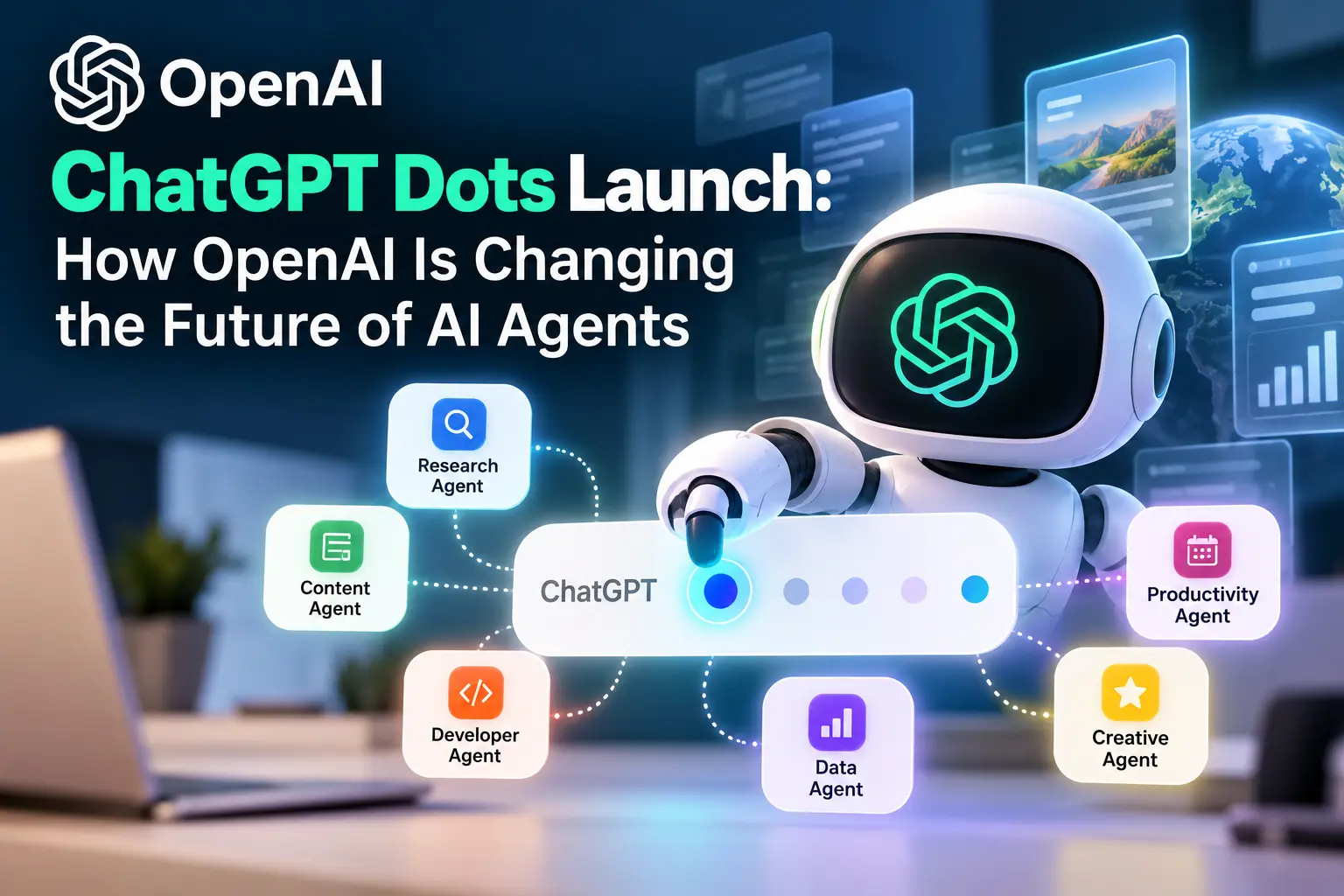
ChatGPT Dots are OpenAI’s always-on agents built to take ongoing responsibility for work. A dot has its own cloud computer and browser, can connect to apps, remember context and continue working toward a goal without requiring constant prompting. OpenAI says Dots can connect through its plugin ecosystem to more than 4,000 apps.
Dots can also work across ChatGPT, Slack and Teams, and can bring completed work back to a person for review. OpenAI is gradually rolling them out to Pro and Business Premium users, with Enterprise access currently available as a beta when enabled by an administrator.
How AI Agents Are Different From Traditional AI Chatbots
A chatbot generally waits for a prompt and responds. An agent can be given a goal and work through the steps required to achieve it. That difference matters for business. Instead of asking AI to draft a weekly report, for example, an agent could gather information, work across connected tools, prepare the report and return it for approval.
Why Businesses Are Adopting AI Agents
The attraction is not simply faster content generation. AI agents can potentially reduce repetitive work across research, reporting, marketing operations, sales administration, customer support and internal processes.
The important word is potentially. Businesses still need permissions, review processes and clear boundaries around what an agent can do independently.
Grok Bot vs ChatGPT Dots: Features and Capabilities
|
Capability |
Grok Bot |
ChatGPT Dots |
|
Persistent AI agent |
Yes |
Yes |
|
Cloud computer |
Yes |
Yes |
|
Browser automation |
Yes |
Yes |
|
File and computer tools |
Yes |
Yes |
|
Persistent context |
Yes |
Yes |
|
Connected apps |
Yes |
Yes |
|
Multi-agent workflows |
Strong focus |
Supported through agent capabilities |
|
Workflow learning |
Skills and routines |
Learns preferences and workflows |
|
Human approval |
Yes |
Yes |
|
Business/enterprise availability |
Depends on plan/workspace |
Business Premium and Enterprise beta availability |
AI Agent Architecture
Grok Bot is built around the idea of named AI teammates that retain their own context and tools. Dots take a similar persistent-agent approach, with each dot working from its own cloud computer and connected apps.
The distinction is less about whether either product is “agentic” and more about how your business wants those agents to operate.
Automation and Background Tasks
This is where both become substantially more useful than ordinary chatbots.
Grok Bot can save demonstrated workflows as skills and routines, while Dots are designed to continue working on ongoing responsibilities and recurring work.
For a marketing team, that could mean recurring research or reporting, campaign monitoring, content planning, or managing activities such as ChatGPT Ads. For operations, it could mean handling repetitive digital processes.
Cloud Computer and Browser Capabilities
Both products provide agents with their own cloud computing environment.
Grok Bot can use a browser, files, terminal and connected tools, with work continuing even when the user's laptop is closed. Dots similarly have their own cloud computer and browser and can work independently before returning results for review.
Memory and Context
Persistent context is one of the biggest differences between agents and conventional chatbots.
Grok Bot retains a Bot’s memory, files, browser sessions and preferences. Dots can remember context and learn from feedback over time, allowing them to understand how a person or team prefers work to be done.
App Integrations and Connected Tools
Dots have a notable advantage in the breadth of OpenAI’s stated app ecosystem, with access to more than 4,000 apps through its plugin ecosystem.
Grok Bot takes a more computer-centric approach, combining connectors with browser and computer use. That can be particularly useful when a workflow involves websites or applications that do not have a dedicated integration.
Multi-Agent and Team Workflows
Grok Bot is particularly interesting for multi-agent work. Its Bots can run in parallel, communicate with one another, share context and hand off tasks.
OpenAI is also moving toward teams of Dots and specialist agents, so this is unlikely to remain a one-agent-at-a-time market.
Privacy, Permissions and Human Oversight
This is where businesses should slow down.
An agent with access to email, files, browsers and business systems can do much more than a chatbot, but it can also create greater operational risk. Both platforms provide mechanisms for human intervention and approvals. Grok Bot, for example, can hand control back to a person for passwords, two-factor authentication, CAPTCHA, payments or identity checks.
Businesses should therefore define permissions, approval thresholds and sensitive-data rules before allowing an agent to operate independently.
Grok Bot vs ChatGPT Dots: Which Is Better for Businesses?
Best for Small Businesses and Startups
ChatGPT Dots may be the easier choice for teams already using ChatGPT and its wider ecosystem. Grok Bot becomes attractive when the business needs persistent computer-based workflows and flexible browser automation.
Best for Marketing Teams
The answer depends on the team's existing stack. If your marketing workflow is already built around ChatGPT, Dots can fit naturally. If your team values persistent AI teammates that can learn browser-based processes, Grok Bot deserves serious consideration.
Best for Complex Workflows
Grok Bot currently stands out for its explicit multi-Bot model, persistent computer environment and workflow-learning capabilities. Dots, however, are built around long-running responsibility, connected apps and an expanding ecosystem.
Best for Productivity and Research
Both can handle this category well. The deciding factor should be the applications, data sources and approval processes that your team already uses.
Key Factors Businesses Should Consider Before Choosing
Before buying either, evaluate:
- What tasks need automation?
- Which apps and systems must the agent access?
- How much autonomy is acceptable?
- Where must human approval remain mandatory?
- What data can the agent access?
- How easily can your team monitor and audit its work?
- Does the agent fit your existing business software?
Do not choose an AI agent because it looks impressive in a demo. Choose it because it solves a real operational problem.
Final Words: Grok Bot or ChatGPT Dots?
The Grok Bot vs ChatGPT Dots debate does not have a one-word winner.
Choose ChatGPT Dots if your business wants an always-on agent deeply connected to the ChatGPT ecosystem, connected applications and ongoing business work. Choose Grok Bot if persistent AI teammates, computer-based automation, workflow learning and multi-agent coordination are higher priorities.
And for most businesses, the smartest approach is to start smaller than the technology suggests.
Pick one measurable workflow. Give the agent limited access. Keep human approval where the consequences matter. Measure time saved, accuracy, completion rate and business impact.
That is how AI agents for business move from an exciting demo to a useful business capability.
Which AI Agent Should Your Business Choose?
Start with the workflow, not the tool. If your business needs help identifying where AI agents can create measurable value across SEO, AEO, GEO performance marketing and lead generation, Saletify can help you build AI Marketing strategy around your existing business processes.
FAQs:
-
What is the difference between Grok Bot and ChatGPT Dots?
Grok Bot and ChatGPT Dots are both persistent AI agents designed to handle ongoing tasks. Grok Bot emphasises AI teammates, persistent computer environments, workflow learning and multi-agent coordination, while Dots focus on ongoing responsibility, connected apps and the ChatGPT ecosystem.
-
Which is better for businesses, Grok Bot or ChatGPT Dots?
Neither is universally better. ChatGPT Dots may suit businesses already invested in ChatGPT and its connected ecosystem, while Grok Bot may suit teams prioritising computer-based automation and multi-agent workflows.
-
Can Grok Bot automate business workflows?
Yes. Grok Bot can use a persistent cloud computer, browser, files, terminal and connected tools. It can also learn demonstrated workflows, save them as skills and run routines.
-
Can ChatGPT Dots automate business tasks?
Yes. Dots are designed to take ongoing responsibility for work, use a cloud computer and connected apps, and continue working toward goals without requiring constant prompting.
-
Which AI agent is better for marketing and SEO?
Both can support research, reporting, content workflows and repetitive marketing tasks. The better option depends on the team's existing tools and the level of automation required. Strategic SEO, AEO and GEO decisions should still involve human oversight.
-
Are Grok Bot and ChatGPT Dots suitable for small businesses?
They can be, particularly when used for clearly defined repetitive workflows. Small businesses should begin with low-risk tasks, measure the results and expand agent permissions gradually.
-
Which AI agent is better for productivity and research?
Both can support productivity and research. Dots are attractive for teams already using ChatGPT and connected apps, while Grok Bot can be useful where browser, computer and repeatable workflow automation are central requirements.