

Why High-Ranking Articles Suddenly Stop Performing in 2026
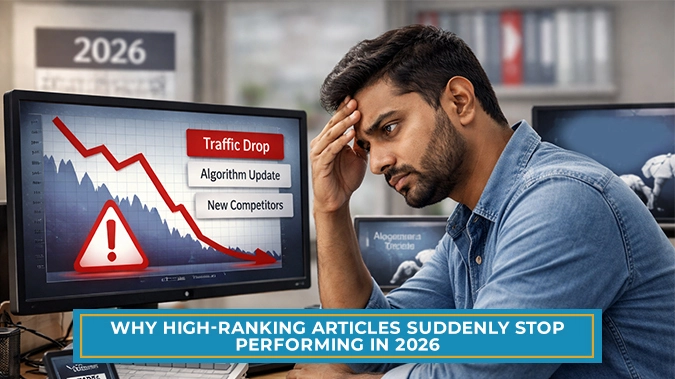
High-ranking articles can suddenly lose traffic in 2026 because of AI-driven search results, evolving Google algorithms, content decay, and shifting user intent. Understanding these factors is essential to identify performance drops, refresh content, strengthen authority, and regain lost visibility. This guide explains why articles stop performing and how businesses can recover rankings effectively.
Today, many website owners, marketers, and founders are unsure of how to move forward after a sudden decline in SEO traffic for their websites in 2026. Even though their website rankings seem to remain intact, and their content is still providing value, they are noticing a significant drop in the number of clicks on their web page. If you have been struggling with a decline in article ranking or saw a sudden decline in SEO traffic, the challenges presented here are much larger than traditional SEO-related concerns. The changes occurring are not only changes to your content, but they will also change how consumers search for and interact with content online.
Moreover, with search engine advancements like AI-generated content and AI-generated summaries, consumers today can now find answers through Google without ever clicking through to a website. AI-generated quality content now accounts for more search results than organic searches. In addition, many AI-powered tools are able to intercept user queries before the consumers even reach the search engine. The rising trend of content decay SEO and the continued shift in consumer perceptions of how they want to find and interact with content in 2026 will further decimate the performance of high-ranking articles. At the same time, it is also expected that these transitions will eliminate the need for businesses to adapt to the new landscape of the market.
What Is Content Decay and Why It Happens Faster in 2026
Content decay refers to the gradual decline in rankings and traffic over time. In 2026, content decay SEO 2026 is happening faster due to increased competition, AI-generated content, and constant search engine updates.
Earlier, content could rank well for years with minimal updates. Today, even top-performing pages can lose visibility within months if they are not actively maintained. This is largely driven by evolving algorithms and shifting search expectations.
7 Reasons Why High Ranking Content Drops
In Search Engine Optimization, one of the key elements is rankings. The goal of every marketer is to achieve the top rank on the first page of the search engine results page (SERPs) for keywords or searches that are related to their business. Here, we will explore key reasons that could lead to drop in rankings and the solutions to fix them:
1. Google Algorithm Updates
At first, you need to check the frequent updates that could change the algorithm of how content is evaluated. For instance, updates like Helpful Content Updates (HCU) have a direct HCU impact on old content, especially if it lacks depth or originality.
2. AI Overviews Taking Clicks
These days, AI-generated answers from Google are reducing clicks on traditional organic results. Moreover, the rise of AI overviews replacing organic clicks means even top-ranking articles may receive less traffic.
3. Search Intent Changes
In digital marketing, content intent plays a key role. With time, user intent has evolved a lot. A keyword that once required informational content are now demanding transactional or comparison-based content. This notable shift is a major cause of Google ranking drop reasons 2026.
4. Competitor Content Improvements
Your competitors are constantly updating and improving their content. If your page stays static, it loses relevance, leading to article performance decline fix challenges.
5. Outdated Information
Content that lacks freshness loses credibility. Content freshness and Google rankings are closely linked, especially for fast-changing industries like SaaS and digital marketing.
6. Weak EEAT Signals
Google prioritizes Experience, Expertise, Authority, and Trust. Weak signals here can cause topical authority content loss. Aligning content with Google EEAT guidelines is now essential.
7. Poor Internal Linking
Without proper internal linking, your content loses contextual relevance. Strategic linking using SEO techniques to grow organic traffic helps maintain authority and discoverability.
How To Identify if Your Content Is Losing Performance
All traffic drops are not sudden. In many cases, content performance declines gradually, making it harder to detect until the impact becomes significant. Monitoring the right metrics consistently can help you identify early warning signs and take corrective action before rankings drop drastically. Here are some clear indicators that your content can be losing performance:
Here are some clear indicators that your content may be losing performance:
- Declining keyword rankings
- Reduced impressions in Google Search Console
- Lower click-through rates (CTR)
- Drop in conversions despite stable traffic
- Increased SERP volatility 2026 causes affecting your niche
- Pages slipping from page one to page two or beyond
- Reduced engagement metrics such as time on page or higher bounce rates
You may also notice that competitors are outranking your content with updated or more in-depth articles. This often signals a transition in search intent or content expectations. Regular SEO audits, performance tracking, and content reviews help detect these early signs before rankings collapse completely. Taking action early allows you to recover faster and maintain consistent organic growth.
7 Proven Ways To Recover Rankings
1. Content Refresh Strategy
Update outdated information, add new data, and improve readability. Content refresh is one of the most effective ways to handle why SEO traffic drops suddenly.
2. Intent Optimization
Match your content with current search intent. Analyze top-ranking pages and adjust accordingly.
3. Topical Authority Building
Expand related topics to strengthen your authority. This reduces the risk of topical authority content loss and improves long-term rankings.
4. EEAT Improvements
Add author credibility, real examples, and trusted references. Following Google EEAT guidelines helps rebuild trust signals.
5. Content Depth Expansion
Thin content struggles in 2026. Add detailed explanations, examples, and structured answers to improve engagement.
6. Internal Link Clusters
Build strong internal links across related pages. Many businesses rely on content marketing services to create effective content clusters that boost rankings.
7. AI Search Optimization
You need to step ahead by learning how to structure content for AI-driven search. Use clear headings, bullet points, and concise answers. Utilizing tools like AI SEO tools for businesses helps optimize for AI-driven SERPs.
How to Make Your SEO Resilient for the Future
SEO is no longer just about rankings. It is about visibility across multiple search experiences. Businesses that treat SEO as an ongoing process rather than a one-time effort will continue to win.
To stay ahead:
- Optimize for AI search using Generative Engine Optimization
- Adapt strategies with Artificial Intelligence Optimization (AIO)
- Focus on user intent and experience
- Maintain consistent content updates
- Build authority through high-quality backlinks
In a Nutshell
If your rankings have dropped, it doesn’t mean your content has failed. It simply means the search landscape has changed.
In 2026, success depends on continuous optimization, understanding search intent, and adapting to AI-driven search. Partnering with a reliable SEO company in Pune or a trusted digital marketing agency in Pune can help businesses identify issues, recover lost rankings, and build sustainable growth strategies.
If your rankings have dropped suddenly, our experts at Saletify can help you diagnose the issue and recover lost traffic. Get your free SEO audit today and rebuild your growth with proven strategies.
FAQs:
- Why do high-ranking articles suddenly lose traffic?
Due to algorithm updates, AI search changes, outdated content, and shifting user intent, rankings can drop unexpectedly. This is especially common in 2026, where AI-driven results and evolving SERP features reduce organic clicks even for well-ranking pages.
- What is content decay in SEO?
Content decay is the gradual decline in rankings and traffic due to outdated information, competition, or lack of updates. Regularly refreshing and optimizing content is essential to maintain visibility and stay relevant in search results.
- How can I fix a sudden ranking drop?
Update content, improve intent alignment, strengthen EEAT signals, and optimize internal linking. In addition, conducting a detailed SEO audit can help identify technical issues or gaps affecting performance.
- How often should I update content?
Ideally every 3–6 months, depending on industry changes and competition. High-competition niches or rapidly evolving topics may require more frequent updates to stay competitive.
- Is SEO still effective in 2026?
Yes, but it requires adapting to AI search, user intent, and continuous content optimization. Businesses that focus on long-term strategy and user-focused content will continue to see sustainable growth.