
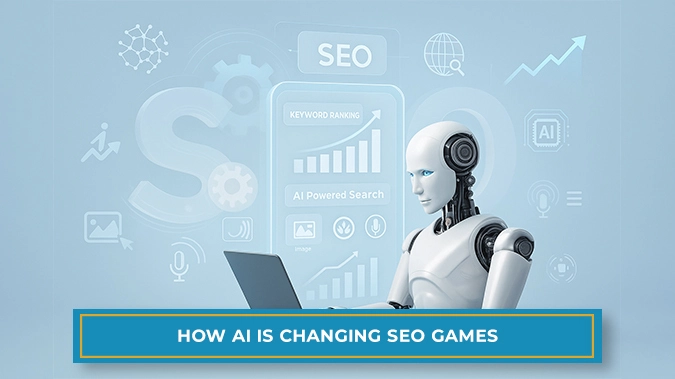
How Artificial Intelligence Is Transforming SEO in 2026
If you’ve ever tried to get your website to rank on Google, you already know it’s not easy. The internet is overflowing with content. With nearly 2 billion websites out there and more being added every single day, standing out feels impossible. And odds are, several of those websites are offering the exact same thing as you.
So here’s the big question: When someone searches for something you offer, who do they find first? You or your competitor? In 2026, SEO is changing in a big way, and it’s all because of artificial intelligence. Let’s take a closer look and explore how.
What is AI for SEO?
AI for SEO means using artificial intelligence to improve your search rankings.
Statistics show that 75% of users don’t scroll beyond the first page of search results. Even more striking, the top result receives about 20.5% of all clicks, while the second and third get 13.32% and 13.14%, respectively. That means the difference between being first and third can cost you a huge chunk of traffic.
Artificial intelligence SEO works a lot like a smart assistant. It reads data, predicts trends like a strategist, and builds content like someone who understands both your users and Google’s rules.
Through tools like chatbot marketing and smart automation, AI makes your work quicker and gives you a stronger sense of direction.
How AI Leverages SEO?
SEO used to feel like guesswork—doing keyword research, fixing links, publishing content, and hoping Google would notice. It worked, but slowly. But AI for SEO changes that.
AI helps you analyse millions of search queries in seconds, figure out what your audience actually wants, and guide you through creating content that’s not just optimised, but actually useful. In fact, it can help you understand what your audience needs before they even search for it.
AI-powered SEO tools empower businesses of all sizes, whether you’re a solo entrepreneur or working with a digital marketing agency, to achieve smarter results faster.
How AI Helps with Keyword Research
Let’s start with something that every digital marketer knows is important: keywords. They’re the foundation of SEO, crucial for organic traffic growth. But picking the right ones isn’t as easy as typing into Google’s search bar. There are different types of keywords, different levels of competition, and so much to consider.
Thanks to artificial intelligence for SEO, keyword research is no longer just a guessing game. AI tools can now identify:
- Trending keywords that are gaining popularity
- Low-competition search terms with high potential
- Related keyword groups organised by intent and topic
- Long-tail phrases people are likely to search next week, not just today
For example, tools like Semrush’s Keyword Magic Tool, Ahrefs, MarketMuse, and Clearscope let you dig deeper into what people are searching for and why. They show you which keywords are worth your time and how to build your content around them.
So, when people ask how to use AI for SEO, keyword research is often the best place to start. It saves time, removes the guesswork, and puts you ahead of the competition right from the beginning.
AI and Content Creation: Write Less, Say More
Creating content has always been one of the most time-consuming parts of SEO. You need to research topics, structure your ideas, write clearly, and optimise the piece for both readers and search engines.
But in 2026, SEO services and tools are making this process smoother. They show you what questions your audience is asking, suggest headings that match search intent, and even help you keep your tone friendly and on-point.
On-Page SEO in 2026: Getting the Details Right
Even the best content can get buried if the technical details aren’t handled right. That’s where on-page SEO comes in, and AI is making it much easier to get it right.
AI tools like Surfer SEO, PageOptimizer Pro, and NitroPack give you live feedback on what’s working and what needs improvement. They’ll tell you if your page is too slow, if you’re missing structure, or if you’ve got the right balance of keywords and readability.
Search engine marketing techniques are no longer limited to keyword stuffing or backlink hunting. In 2026, they’re all about user experience. And AI makes sure your website delivers exactly that.
Link Building with AI: Smarter, Not Harder
Everyone knows backlinks are important for SEO. They signal trust to search engines and help your pages rank higher. But the old ways of link building - cold emails, outreach templates, and hours of research - are slow and often hit-or-miss.
Today, tools powered by AI, such as Respona, BuzzStream AI, Pitchbox, and LinkHunter, are bringing a new way of doing things. Instead of sending out generic emails to random sites, you’re finding perfect-fit websites based on niche, audience, and relevance.
Bottom Line
Whether you’re running a blog, building a startup, or even managing a growing business, AI can help you make smarter choices, get found online faster, and create content that people care about. With artificial intelligence SEO, things finally make sense.
If you want to implement AI-driven SEO strategies effectively, partnering with an experienced SEO company in Pune can help you stay ahead of algorithm changes and achieve long-term growth.
FAQs
Can AI completely replace human SEO experts?
AI has become incredibly smart, but it is not here to take over the role of SEO professionals. What it can do is support, assist, and speed up certain parts of the process. The most effective artificial intelligence SEO strategies still need the human touch to guide the overall direction.
Is AI-based SEO suitable for small businesses or only large enterprises?
Artificial intelligence for SEO is not only for big companies. Even small businesses can use it and see great results. With the right help, a local shop or a solo entrepreneur can use AI to find keywords, write better content, and see how their website is doing.
Does Google penalise AI-generated content?
No, Google does not penalise content solely because it’s AI-generated. What they actually care about is whether the content is helpful and valuable to people. If you’re using artificial intelligence SEO to make content that helps your readers and is relevant, you’re totally in the clear.
How does AI affect voice search optimisation?
People tend to ask full questions out loud when they use voice search. And AI is amazing at understanding how people naturally speak when asking questions. It helps you find more natural, chat-like keywords and shape your content in a way that actually answers those spoken questions.
Can AI help with multilingual or international SEO?
Yes, and more than you might expect. Artificial intelligence for SEO tools today is designed not just to translate your content but also to localise it. If your business is trying to reach people in other countries or speak to different language audiences, AI makes that way easier than it used to be.
What are the risks of over-relying on AI for SEO?
AI is a helpful guide, but depending on it too much can take away the originality and depth that come from a human perspective. The content might start to feel repetitive or lack personality. AI can tell you what works, but it cannot always feel what connects. The best results come when you use AI to support your creativity, not replace it.
Last Updated: 07-Febuary-2026